
A Legacy Served with Restraint: Chef Sweety Singh at Spice Kitchen, JW Marriott Pune
Updated: Apr 18
An Arrival Rooted in Lineage
There are chefs who build their identity through innovation, and then there are those who inherit it through legacy. Chef Harjinder Singh aka Sweety Singh belongs unequivocally to the latter.
Beginning 17th April onwards until 26th April (from 7 PM) at Spice Kitchen, JW Marriott Pune, and this showcase is not positioned as a conventional food festival. Instead, it presents something far rarer—a living continuation of Punjabi culinary tradition, carried forward through memory, discipline, and time.
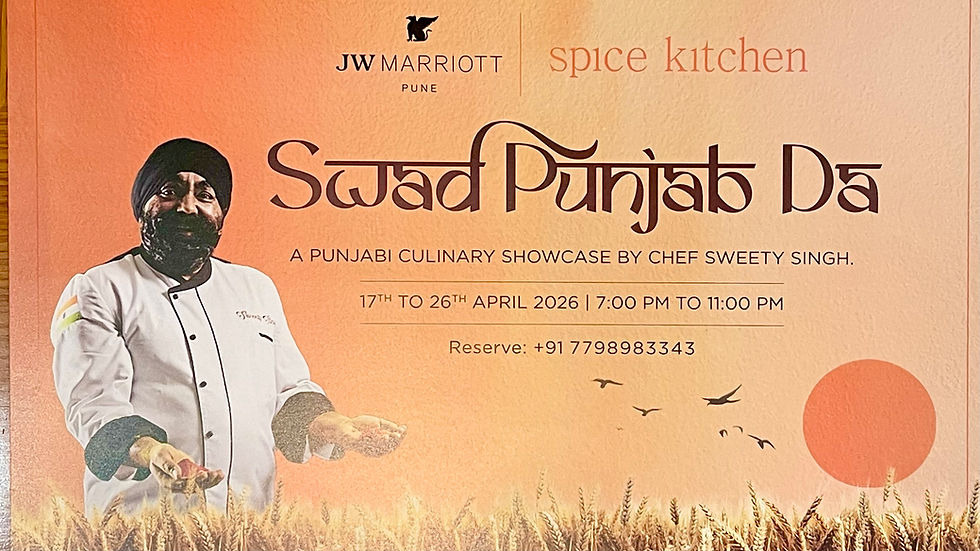
Chef Sweety Singh’s foundation lies in the dhaba culture of Old Delhi, where food was never stylised for presentation, but shaped by necessity and repetition. His learning was not institutional; it was observational. Recipes were not documented—they were absorbed, refined, and preserved.
A Career Built on Authenticity, Not Assertion
Over the decades, Chef Sweety Singh has quietly established himself as a respected ambassador of Punjabi cuisine across leading hospitality platforms in India and abroad. His work has consistently resisted the pressures of modern reinterpretation.
In an industry that often rewards exaggeration, his approach has remained grounded. He has chosen not to adapt Punjabi cuisine for visual appeal or commercial trends, but to present it as it was meant to be experienced—uncomplicated, honest, and deeply rooted.
This restraint is not limitation; it is mastery.
The Philosophy of Balance
At the core of Chef Sweety Singh’s cooking lies a principle that is increasingly rare in contemporary kitchens—balance without excess.

Flavours, under his hand, are neither amplified nor diluted. They are composed with a clarity that reflects an intuitive understanding of ingredients and time. There is no reliance on cream, excessive butter, or overt richness to create impact, nor any attempt to disguise technique through garnish.
Instead, his food is guided by patience.
Slow cooking, measured seasoning, and an instinctive sense of proportion define his style. It is a cuisine that does not seek immediate approval, but rewards attention and engagement. Nothing feels greasy, fatty, or unnecessarily heavy—each dish is allowed to stand on its own integrity.
A Tasting Defined by Clarity
Having approached the experience with intent, I tasted and tested, sampling nearly every offering—often just a spoonful at a time, enough to understand its structure, balance, and finish.
What stood out was not excess, but consistency.

Each dish reflected control. Flavours were handled with precision, not force. There was no cumulative heaviness on the palate, no fatigue that typically accompanies indulgent spreads. Instead, there was a sense of ease—of food that had been carefully thought through and respectfully executed.
Across the board, the dishes held their own.
Each one, in its own way, was excellent—not by extravagance, but by clarity.
My experience opened with a kesar lassi, personally offered by the chef—thick, composed, and lingering with a gentle saffron warmth—followed by a zeera lassi that provided contrast through its sharper, cumin-led profile. The vegetarian starters established an assured beginning: the Highway paneer tikka carried a rustic smokiness with well-integrated marinade, while the bharwa soya chaap delivered a firmer, more assertive spice structure.
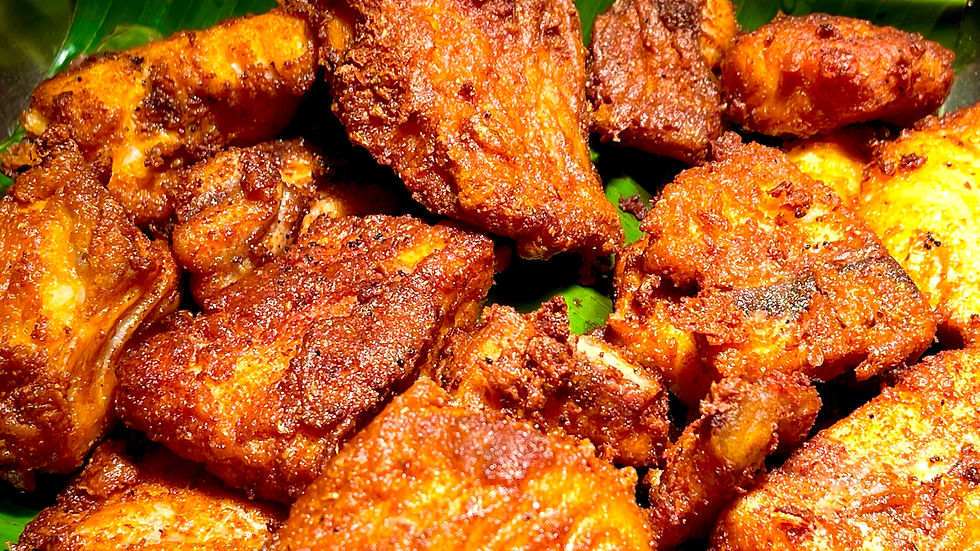
The first decisive shift, however, arrived with the lausani Lahori chicken tikka—one of the defining showstoppers of the meal. Garlic-forward yet precisely controlled, it revealed a marinade that had penetrated deeply, resulting in meat that was both succulent and structurally intact, finished with a confident char. Alongside, the Amritsari fish fry stood at equal stature—its coating crisp without heaviness, allowing the fish to retain clarity and moisture, seasoned with notable restraint.
The mains continued this momentum with conviction. The butter chicken emerged as a central anchor—silken, layered, and remarkably composed, achieving a balance of sweetness, tang, and depth that elevated it beyond familiarity into benchmark territory. The sarson wali jhinga followed as a striking regional articulation, where mustard’s assertiveness was used with precision to cut through the sweetness of the prawns, creating a dish that was both bold and disciplined. The bhuna meat masala remained grounded and traditional in its slow-cooked intensity, while the kali mirch chicken pulao offered a quieter, aromatic counterpoint.

On the vegetarian side, the Amritsari kulcha with chole and pyaaz ki chutney stood firmly among the meal’s defining highlights. The kulcha arrived blistered and texturally precise—crisp at the edges, soft within—paired with chole that were robust yet controlled, lifted by the sharpness of the onion chutney. The sarson ka saag provided an earthy, familiar depth, best accompanied by the maa de makhan wali dal, slow-cooked to a velvety consistency that reflected both patience and technical assurance.

The khumb masala revealed itself as a quieter but equally compelling standout, the mushrooms absorbing the masala to create a dish of notable depth and cohesion. The aloo wadi introduced a homely, textural contrast, while the butter paneer masala and matar pulao completed the progression with balance and familiarity. Across the meal, what remained consistent was not indulgence, but intent—each dish defined by clarity rather than excess.
Reframing Punjabi Cuisine
I must admit that Punjabi food, as it exists in most urban dining spaces today, has been reduced to a predictable formula—rich gravies, heavy textures, and uniform flavour profiles.
Chef Sweety Singh’s work stands in quiet contrast to this narrative.

His interpretation moves away from excess and returns to origin. It challenges the assumption that richness alone defines authenticity, and instead reintroduces depth, structure, and restraint as essential markers of quality.
This is not a reinvention of Punjabi cuisine.
It is a restoration.
Why This Experience Matters
For Pune’s diners, this is more than a seasonal offering.
It is an opportunity to encounter Punjabi cuisine beyond its commercialised identity—to experience flavours that are shaped by legacy rather than trend.

There is a certain stillness to this approach. No urgency to impress. No need to perform.
And within that stillness lies its strength.
Acknowledgement & Service Appreciation
Well… An experience of this nature is never the work of a single individual.
The production behind such an experience warrants equal recognition. Sincere appreciation is extended to the kitchen brigade—Chef Shreyas, Sevak Singh, Preetam Singh, Birender Singh, Akshay Deshpande and Rahul Rawat—whose discipline and consistency ensured that each dish was executed with integrity and precision.
Their collective effort allowed the cuisine to be presented with the dignity and discipline it deserves.
Sincerest thanks, with genuine appreciation, to the dining room team for their polished and attentive service—gracefully conducted under the supervision of Rajan Khurana, the dining room team—Pawan, Mahaveer, Gaurav, Praveen, Kamal, Bhaskar, Suraj, Kshitij, Rohit and Dhananjay—maintained an attentive yet unobtrusive presence, allowing the cuisine to remain the central narrative while ensuring a seamless flow throughout.
Gratitude is also due to the senior leadership of the hotel for envisioning and executing an initiative of this depth and cultural integrity—bringing to Pune the flavours of the land of five sacred rivers, Punjab.
Sincere appreciation to Mr. Rahul Gautam (Director Operations), Mr. Suyash Bisht (Director F&B), Mr. Nagesh (Associate Director F&B), Mr. Amit Negi (Director Restaurants), and Mr. Aasim Patial, and specifically to Executive Chef Sajid Patel and Executive Sous Chef Pradeep Singh whose collective commitment made it possible for the city of Peshwas to experience this thoughtful and immersive culinary expression.

An Invitation to Engage
From 17th to 26th April, evenings at Spice Kitchen, this experience offers more than a meal. It presents a perspective—one that invites diners to move beyond expectation and engage with food in its most honest form.
For those who value depth over display, and authenticity over indulgence, this is an experience worth seeking out.
Manav Kaushik
Don't Waste Food (DWF)


Comments